Welcome to our Hunter class guide for Lord of the Rings Online! Here you will learn about the play-style of the Hunter for solo, landscape, or dungeon game play. This guide will cover Hunter build suggestions, which virtues to slot, which vocations are useful, and tips on how to play your Hunter.
If you’re a new player or returning to LOTRO after a long break and would like a refresher, take a seat at the campfire and join me as we cover all things related to the Hunter class.
Table of Contents

Who are the Hunters of Middle-earth?
The Hunters in LOTRO were inspired by Legolas, the Prince of the Woodland Realm and son of Thranduil, King of Mirkwood. Legolas was an accomplished bowmaster and tracker, with enhanced hearing and eyesight. His weapons of choice were an Elven bow and a long white knife. One of the most tireless members of the Fellowship, Legolas combated enemies from range with his bow and when in close combat, use his blade.

The Play-Style of the Hunter
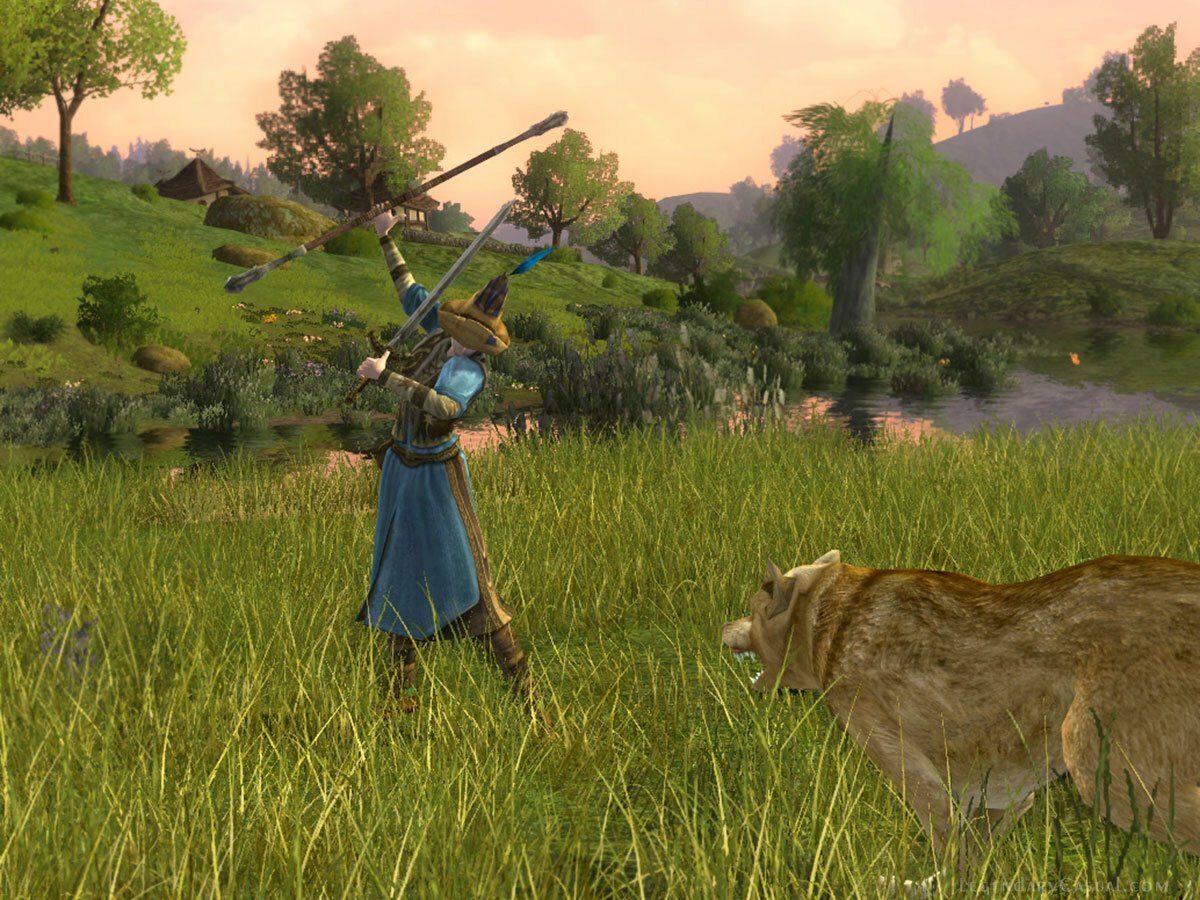
The Hunter class is for players who like fast paced and hard hitting ranged combat, this class will also appeal to anyone who enjoys attacking from afar, the challenge of kiting monsters, planning trap placement, and having improved travel options and movement speed while on foot.
Masters of field and forest, the Hunter excels in combat with the bow and defeating single-target enemies from range. When approached in close combat the Hunter uses its dual-wield weapons to engage the enemy. Their traps are helpful for taking on multiple targets. Hunter’s are considered an easy class to learn and their role is damage.
The Hunter is a popular class in LOTRO and any server you log into will find they are almost always the most populated class online.
Fast Travelers
If you like having the ability to quickly travel from one area to another this is another win for the Hunter class as you can teleport to 50 different locations around Middle-earth with the click of a button and transport your whole Fellowship too.
Hunter guide skills are an essential part of the class and we have a separate article on how to obtain all the Hunter travel skills, it is an extensive list and definitely worth the read if you are considering this class.
Combat Mechanics
As a ranged class the Hunter operates on Power and Focus, a resource your Hunter uses to power attacks and other skills. You build Focus during combat using your Focus building skills and spend it on your Hunter’s most powerful abilities.
The skill animations are a ranger type of combat, shooting arrows doesn’t actually appear magical or sparkle like it does in some other games, in LOTRO you nock and loose your bow and the arrow flies with minimal spell animation. However, you can apply Fire Oil or Light Oil to add some fiery and light type animations to your spells for a duration. If you’re wanting a more spell casting type of class, the Lore-master or Rune-keeper offer “magical” kinds of spells for ranged combat.
Survival and Utility
Tracking your foes is a breeze as the Hunter learns different skills to find specific types of targets, and hunting allows for the placement of traps to strategically take down an enemy or for your protection during combat.

Which Race is Best for a Hunter?
Hunters can be the following races: Dwarf, Elf, High Elf, Hobbit, Man, or Stout Axe. If you’re looking for the best Hunter race in terms of damage output you would want to go with the Elf race, if you want to be a bit hardy choose Hobbit, if you like utility the Race of Man.
Elves passively gain +15 Agility and can earn the racial traits Elf Bow-damage Bonus which offers +5% to bow damage and the Elf One-handed Sword-damage Bonus gives +5% damage with one-hand swords.
Hobbits have Rapid Recovery which allows for +60 non-combat morale regeneration, so you’re healing up rather quickly on the move and out of combat. Hobbits also offer +15 Vitality with Hobbit-toughness, extra health and higher resistances can be advantageous for a Hunter. Feigning death and dropping aggro from monsters can also be useful with the Hobbit racial trait, Hobbit-silence, though it comes with a 30-minute cool-down.
The Race of Man offers two racial traits that can be useful for Hunters, the Duty-Bound skill provides a buff to the Fellowship of +5% max morale for 10 minutes and the Strength of Morale skill gives the Hunter an extra heal of 2200-3300 morale, though both of these skills have a 30 minute cool-down.
The question of which race is best for a class has always been a subjective topic, and I stand by the recommendation of choosing the race that is most meaningful for you and your play-style.
Looking for the right LOTRO class? Check out our Choosing a Class Guide to find the best fit for your playstyle, whether you want to tank, heal, or deal damage.🧙
Essential Hunter Stats
The Hunter can equip Light or Medium armor and will want to look for Medium armor that has Agility and Vitality stats for the best possible damage output while having a good Morale pool to survive attacks. At higher levels you want to add Physical Mastery and Critical Rating. Physical Mastery increases your ranged and melee damage, and Critical Rating increases your chance to land a critical hit and the magnitude of a devastating hit for your melee and ranged attacks.
Hunter Weapons & Equipment
A bow (or cross-bow) is the Hunter’s ranged weapon and they also dual wield one-handed weapons like axes, clubs, daggers, hammers, maces, spears, and swords. The spear can be equipped into the main hand only. While you rarely confront monsters in melee combat you want to have good quality melee weapons to further your stats.
Each class in LOTRO has a Class Slot on your character panel, for Hunters this slot is equipped with Hunter Books. The books offer additional stats to increase your Morale or Vitality and decrease your ranged threat or reduce power costs of your skills. There are a variety of Hunter books to equip, you can buy them from your Class Trainer, and they can be crafted by a Scholar and traded or sold in the Auction House.
Crafting for Hunters
Here are some crafting suggestions that offer the most useful items for the Hunter class.
Tailor can make Medium armor, which is some of the best gear you can get especially while leveling.
The Forester and Prospector gather materials such as wood/ore that you can funnel to your other characters to process or to sell the raw materials on the Auction House to make coin.
Scholar paired with Farmer make several useful items for your Hunter, they craft Fire/Light Oils that can be applied to your weapons to deal some extra damage and slightly change up the way your skills look.
The Scholar can also make Hunter Books, your class slot item and they craft Bow Chants that empower your bow for a duration. Then of course they can make potions, scrolls, and dyes for your armor and cosmetics.
If you would like an overview of all the crafting professions, check out our LOTRO Crafting Guide.

Best Hunter Virtues – Which Should Be Slotted?
Virtues offer stat bonuses for your character, here are some of the best Virtues for your Hunter and why. You can slot 5 Virtues at a time and all Virtue slots will be unlocked by level 23. Each Virtue’s first stat is the highest for that Virtue, the additional stats are slightly lower than the first and so on. You may want to take that into consideration when choosing your Virtues.
Determination adds Agility, Physical Mastery Rating, and Critical Rating, the Hunters most important stats for offensive damage. It also adds Passive bonuses for Physical Mastery Rating and Tactical Mastery Rating. Boosting morale recovery and increasing morale.
Valour for Physical Mastery Rating, Finesse Rating, Critical Rating and passive bonuses for Physical Mastery Rating and Tactical Mastery Rating. Finesse Rating adds some reduction to the resistance of enemies and their Block/Parry/Evade ratings.
Loyalty gives Vitality, Armour Value, Incoming Healing Rating and the passive bonus of Maximum Morale. Vitality and Max Morale provides more health to the Hunter, Armour Value increases it’s toughness, and Incoming Healing Rating allows for more healing.
Fortitude adds Maximum Morale, Critical Defense, Resistance Rating, and passive bonus of Maximum Morale. This is a great defensive Virtue, it adds Morale for a higher health pool, and provides some benefit for defense against critical strikes, and resistances to Wound, Fear, Disease, and Poison.
Confidence offers Critical Rating, Finesse Rating, Evade Rating and passive bonuses for Physical Mastery Rating and Tactical Mastery Rating.
Wit provides Finesse Rating, Critical Rating, Physical and Tactical Master Rating. Wit will give you the most Finesse Rating and if you are going for a DPS build, you could swap out Fortitude or Loyalty.
Justice for in-Combat Morale Regen, Maximum Morale, Tactical Mitigation and passive bonus of Maximum Morale. Justice is good for a Hunter who is on the move and likes to have more health/morale regeneration in combat.
Tolerance for Tactical Mitigation, Resistance Rating, Physical Mitigation and passive bonus to Maximum Morale. If you prefer more mitigation from incoming Tactical damage, non-physical attacks.

Tips for Playing Your Hunter
Here are some tips and tricks for learning to play your Hunter and what to expect from the class.
- Building Focus is vital for your Hunter to use your most powerful skills, start your rotation with a Focus builder skill like Quick Shot, Barbed Arrow, or Swift Bow. You can also gain Focus by using Set Trap.
- Continue your rotation by spending the Focus you have generated on more powerful skills like Penetrating Shot, Merciful Shot and Blood Arrow.
- Make sure your Hunter has enabled one of your stances, they can be Strength, Precision, and Endurance. Choose the one that fits your style and the combat you are about to encounter, stances can be changed anytime.
- Before entering combat channel the Focus skill, this will fill your Focus bar up and make combat more efficient. You don’t have to channel the entire 3 second cast, look to your Focus bar to see it fill up, then start combat.
- Blood Arrow is a damage skill that also provides the hunter with a heal that restores 10% of your max morale and removes corruptions from the enemy. This ability can be improved with traits in the blue line Huntsman specialization.
- Use Find The Path, a toggle skill that applies an out-of-combat run speed boost to you and your Fellowship.
- There are several consumables useful to the Hunter class, you want to add some Fire Oil or Light Oil to your bow, and a Bow Chant too. These items can be purchased from the Hunter trainer or at the Auction House, they can also be crafted by a Scholar.
- You can have one of each type of food buff active, so look for Cooked Food, Trail Food, and Fortifying Foods, these can be made by a Cook, purchased in the AH, and some vendors.
- It’s a good idea to carry some Athelas Essence potions for healing Morale, Celebrant Essence potions for regeneration power, and Potions of Focus for filling your Focus bar in a pinch.
- The Hunter has great utility for itself and the fellowship with its traveling guide skills, don’t forget to set your Return To Camp skill, it’s essentially a second Milestone without a cooldown.
- When out of combat you can place a Bright Campfire that heals yourself and nearby allies quickly, it also regenerates your power and provides stealth detection.
- Intent Concentration is a buff that will fill your Focus bar on a 3 minute cooldown, usable in combat.
- If you get in over your head and need to retreat, use Desperate Flight, this skill will instantly teleport you to the nearest rally point safely, use this skill wisely as it has a 30-minute cooldown.
- Cry of the Hunter should be used when you have multiple enemies attacking, especially in close range as it will remove disabling effects, increase your movement speed, and place a shield granting a boost of Morale for a time. You can not be interrupted when inside the bubble.
- As a Hunter you will engage in melee combat sometimes and when that happens you want to use Low Cut which hits up to 3 enemies and Dazing Blow can daze the enemy, these skills will also build Focus.
- The Hunter learns 3 different tracking skills to help you locate specific enemies in an area, very useful when you are looking for a certain rare or quest mob.
- Camouflage allows the Hunter to stealth so long as they remain still, and if you need to drop aggro use Beneath Notice to reduce your threat.
- Bard’s Arrow can fear a target for 15 seconds so long as it doesn’t take damage and Distracting Shot will daze a target for 10 seconds, very helpful skills that can control your enemies.
- At level 15, 30, 50, and 58 visit your class trainer and complete the class quests offered.
- When you reach level 45 you can begin the level 50 Epic quest for your first Legendary weapon, the bow and then continue the story to get your second weapon, a sword.
- Hunters will find plenty of damage increasing stats on their gear and Legendary items, don’t forget to buff your health for better survival, Virtues with morale can help in this area.
Hunter Class Refresh 2025 Updates
The Hunter class refresh arrived with Update 45: Allies and Adversaries, which released on July 23, 2025, and it delivered a substantial pass on the class rather than a handful of isolated tweaks. Hunter damage was increased across the board, Hunter stances were removed, and several core skills were updated, including Quick Shot becoming cheaper and more mobile, Purge Poison gaining broader utility, and the new Oromë’s Arrow giving Hunters a dedicated corruption-removal tool.
A big part of the refresh is how each specialization now has a clearer role. Huntsman (Blue Line) is pushed further toward mobile, induction-free gameplay, with emphasis on movement, bleed interaction, and fast Focus spenders. Bowmaster (Red Line) stays the long-range damage spec, but with stronger direct ranged damage, the new Long Shot, a reworked Heart Seeker, and updates to Burn Hot, Merciful Shot, and other key damage traits to reinforce a steady high-impact archer playstyle.
The most dramatic redesign may be in Trapper of Foes (Yellow Line), which is now positioned much more as a true support line. There has been a shift away from leaning so heavily on traps and roots alone, replacing that with more practical crowd control and utility through skills like Hail of Arrows, Kingsfoil Healing, Blasting Arrow, Distracting Shot, and Horn of Oromë. That gives yellow-line Hunter more group value through debuffs, stuns, healing support, corruption control, and fellowship utility instead of feeling narrowly tied to older trap-based mechanics.
For players jumping into the refreshed class, the biggest takeaway is that Hunter now has more defined build paths depending on whether you want mobility, ranged burst, or support utility. For updated trait setups and recommendations, check out the latest builds here: Hunter Builds created by the LOTRO community.
Onward and Upward
I hope you find this guide to the Hunter class useful in your adventures ahead! Don’t forget to check out our Travel Skills for Hunters guide and if you’re still considering other classes, we have a guide on selecting a class in LOTRO too. Happy Hunting!